Monday, July 14, 2008

Pinchbeck Revisited

Frequent millinerd readers may remember my comment-box exchange with counter-cultural man of the hour, Daniel Pinchbeck. My long promised review of his now paperback book, 2012 , has finally appeared in this month's Touchstone (subscription required). While my fundamental disagreement with Daniel has not changed, what has (I hope) is my tone. This has much to do with our brief meeting in Princeton for coffee and conversation. Our amiable encounter made me feel all the more sheepish for my flippant initial critique. I was, regrettably, well too dismissive in my earlier post, though I quickly learned that in this I was not alone.

Continue...
After the publication of his earlier book, Breaking Open the Head Pinchbeck was proclaimed some kind of guru, a reputation he still enjoys. But following 2012 there was a degree of concern, even disowning, by some of Pinchbeck's colleagues on the Left. The Village Voice was ruthless:
"We have indeed reached a great precipice if the brightest vision a once progressive critic can offer is anointing himself a culture hero. When those who should be just ahead of the curve blast off desperately into the stratosphere, this is a cause for real - if not apocalyptic - alarm."
The New York Times lamented that whereas William Burroughs once transferred drug effects to prose successfully, Pinchbeck often just resorts to CAPS. "Pinchbeck insists the crisis he's trying to help us solve is global," the review continues, "but throughout '2012' there is ample evidence that the crisis is Pinchbeck's own." As reported in my initial post, Pinchbeck's lifestyle even causes Rolling Stone to play the concerned parent: "Two followers who posted frequently on Pinchbeck's online discussion board - both of whom made pilgrimages to New York to meet him - committed suicide in the past few years." And the kiss of death came from Reason Magazine. "He frequently sounds like that other apocalyptic tribe, the Christian fundamentalists."

While the siren song of the New York Times crowd is nearly impossible for many Christians to resist, it would still be regrettable were we to perpetuate, as I did, this dismissive attitude. Chew-outs from the Left are largely based on Pinchbeck's taking the supernatural seriously. How could any Christian follow suit? Consider this passage, where he relates his disillusionment with Manhattan materialism:
"No scientist, as of yet, had figured out how consciousness emerged in the brain - but we were assured that it was only a matter of time before that last detail was ironed out and our three-pound jelly of gray matter yielded up its ultimate secret. Our best minds were working on it around the clock. We could rest assured, as well, that there was no life after death, no continuity of soul or flight of spirit. All that was superstition. What was not superstition was what was factual, quantifiable, tactile; whether nuclear bomb, body count, or skyscraper. Oblivion was not superstition. It awaited us after the music of our allotted time ended and we sucked our last breath."
To take Pinchbeck seriously is not to suggest every New Age manifesto need be scrupulously refuted, for 2012 is no refried Celestine Prophecy. There is some supernatural disillusion as well. Pinchbeck is as critical of the New Age as he is of traditional Christianity. A few examples: After growing skeptical of his relationship with a New Age healer called - you guessed it - "The Mother," Pinchbeck breaks the umbilical chord.
"I disliked the New Age obsession with healing. Healers... start with the notion that there is a sickness, there is a patient, there would be a long drawn-out process of recovery that might not ever quite end in a cure. It seemed to me that healers took control of the narratives of their patients in this way, stripping them of agency, feeding their egocentrism and fantasies of victimization."
The claim of another New Age priestess to be "receiving transmission from an Arcturian mothership located somewhere around the Big Dipper" was, Pinchbeck admits, "too much even for me."

And then there's by far my favorite passage, where the Burning Man bridges get burned.
"The avowed spirituality of West Coast hipsters, which appeared so glamorous and enticing to me at first, increasingly seemed a shallow lifestyle choice - a new form of congratulatory consumerism, a better way to get laid. Dressing in fake Day-Glo furs and dancing at all-night trance parties was not impressive as a spiritual discipline."
In short, 2012 is largely a book about disillusionment with materialism and spiritualism. What the book leaves us with is a bizarre collage of theories with which Pinchbeck is not yet disillusioned (Jungian psychology, interpretation of quantum theory by non-scientists, the Frankfurt School, Nietzchean desperation, anthroposophy, crop circles, Mayan mythology, alien abductions, Amazonian shamanism, and a pinpointed apocalypse).

If his book tells us anything, it is that Daniel Pinchbeck is on a schedule of disenchantment. This is not an insult, but a compliment. There are many things worth giving up on, and Daniel has a track record of seeing through them. Pinchbeck himself admits that his efforts in 2012 are "perhaps tragically misguided." I'd say he's on schedule for fresh disappointment around the time when he tells us the world will end, December 21st, 2012. Then, and well before, one disillusion-proof deity - who like the plumed serpent Quetzalcoatl claims to unite heaven and earth - awaits.


Update:
Incidentally, It would be small-minded of me to exclude the possibility that in finding Christ, Pinchbeck would be fulfilling any and all good he has found in Quetzalcoatl. According to this book on the Virgin of Gaudalupe, the flowers on Mary's mantle
"can be identified with a Nahuatl glyph or symbol for Venus, the Morning and Evening Star. Venus as Morning Star was associated with the god and culture-hero Quetzalcoatl, who after his self-immolation was taken up into heaven as the Morning Star. Quetzalcoatl's teachings were so beneficent and his mythic role so life-giving, that he can be understood as one of the 'seeds' of the Gospel which God has planted in all cultures."
To Christ through Mary? It wouldn't be the first time.

Saturday, June 21, 2008

Cyprus wrap-up

I'm in Greece now for some more research at Mount Menoikeion. I constructed a website (with much assistance) over the semester to convey what it is we're up to. Please feel free to check it out. Below is my Cyprus summary in the form of a credit card commercial:

Listening to extensive reflection on Orthodox/Catholic relations on the flight over to prepare for an intelligent, conciliatory western encounter with Orthodoxy? Free (thanks to Nathaniel).

Arriving at Larnaca at 3am due to an extreme delay, renting a car and traveling straight into the mountains to the church of Panagia tou Araka (my dissertation focus) just in time to get there, after a treacherous mountain pass, for the Pentecost Monday liturgy? A good bit of euros (car rental is not cheap, but bargaining seemed to work).

Getting to see the famous icon at Kykko monastery, and realizing that devotion to the Virgin is far from a distraction - but may in fact be an essential supplement - to a rightly ordered Christian faith? 6 euros for a reminder icon at the gift shop.

Seeing how the Late Antique Dionysios mosaics at Paphos are brilliantly appropriated by the roughly contemporary Christian mosaics at St. Paul's church which proclaim Christ as the "true vine;" and then enjoying a sip of that wine at an Anglican eucharist in that same church? A decent sum of euros (hotel).

Seeing how not only Dionysius, but the Aphrodite cult at Palea Paphos is also appropriated (and thoroughly cleansed) by the Church of the Virgin on the same site, built with some help from the ruins of Aphrodite's defunct temple? 3 euro (entrance fee).

Seeing the famous twelfth century frescoes in the cave church of Neophytos and grasping the parallels of his life to the life of that first monk St. Antony? 2 euros (entrance fee).

Getting to see the tomb of Lazarus at Larnaca? Too many euros (again, those hotels).

Fresh orange juice from the once feudal groves outside the Lusignan castle of Kolossi? 1 euro.

A bag of oranges from the same place? 1 euro.

Realizing, thanks to an innovative modern icon exhibit held within the Venetian gates of Nicosia, that Greek Christianity (far more visually sophisticated than the American kind) has many things to teach Manhattan about contemporary art? Free.

Going back into the Troödhos mountains to see a few more of the stunning painted churches peppered throughout? Too many euros (gas!).

Walking through the Nicosia border, the world's "last divided capital," without incident? Free.

Seeing the stolen, but finally salvaged Kanakariá Virgin mosaics from northern Cyprus at the Byzantine museum in southern Nicosia? 3 euros (museum fee).

Seeing Mt. Athos from a plane and realizing it has long trumped Mount Olympus? A reasonable sum of euros (plane ticket).

Being outside of the U.S. for an extended time during a Presidential campaign season? Priceless.

Thursday, June 19, 2008

Cyprus

Greetings from some internet cafe in Cyprus. It would perhaps sound too much like a Mark Steyn article if I suggested that everyone should journey to the Turkish side of Nicosia, where one can see a soaring Gothic cathedral that is now a mosque, if only to condition themselves for their next trip to England... so I won't say it. Instead I'll ask two questions intended to make everyone in the room uncomfortable.
1. In this sweet age of pluralism, is a mosque in the shell of a Gothic church a multicultural cocktail to be savored, or an imperialistic seizure to be mourned (i.e., under which academic fashion should such structures be filed, multi-culty or colonial)?

2. Why does that same cathedral-now-mosque bear such an uncanny resemblance to the Reformed churches of Amsterdam?
At any rate, this place is well worth a visit, most especially if you're into painted churches. Pumping gas in the homeland was perfect conditioning for the exchange rate.

More, much more, to come.

Thursday, June 05, 2008

ManBearPig Terrorizes Seminary

Theological interpretation, by which we mean the answer to the dilemma of infinite possible readings is a firmly ecclesial one, is so hot right now. This is as it should be. The flood of commentaries (Brazos, Eerdmans and Blackwell), books and articles flow from a growing realization that theological interpretation can kill two birds - modern and postmodern - with one stone.

Modernity's mission impossible to isolate the text's historical context and authorial intent is shown, by advocates of theological interpretation, to be of limited assistance for believers. The historical-critical method is, as someone has so nicely put it, "a revelationally inappropriate hermeneutic." On the postmodern end, if the Bible can be unhinged from any original context or intent, then a faithful answer to the consequent confusion is to read the Scripture through a clearly Christological lens. This is appropriate enough, as Christ has long had a facility for opening scrolls, and without him many of our readings amount to weeping (not to mention a yawn).

A few recent articles have attempted to summarize the long overdue recovery project of theological interpretation. I'm partial to Jason Byassee's entertaining roundup of selected publications. Byassee cites Ireneaus' helpful analogy:
The words of the Bible are like so many tesserae in the hands of a mosaic-maker. They can be arranged to display something disgusting... Or they can be properly arranged to show the image of a king.
Byassee refers us to Lewis Ayres' suggestion in this volume that the literal, or plain sense (as oppose to spiritual sense) of Scripture, does not amount to whatever historical critics want it to mean. The plain sense of the Bible is, simply put, God. Byassee makes a similar point in his own book on the Psalms, arguing for a "christological plain sense." Dan Treier seems to concur in his forthcoming book, an excerpt of which is available in the current Princeton Theological Review (PDF here), an issue also devoted to theological interpretation. Like I said, it's hot right now.

The ManBearPig
There can, however, be ugly consequences to the shift. In some Seminaries today, a monstrous pedagogical hybrid, one part history, one part theology, and eight parts New York Times, prowls about seeking whom it may devour. It is loosed from the moorings of history, resistant to basic Christian claims, and calls itself "theological interpretation." It dismisses historical critical method as the tired methodology of dead white modernist males, but in its place puts anything but a firmly ecclesial read. One O.T. 101 textbook suggests, nay, insists that
It is not appropriate to make... readings conform to any particular pattern of church doctrine.
I imagine the author is driven by a frustration with recalcitrant Seminarians who refuse to permit the Hebrew Scriptures their original contexts. This is indeed a besetting sin of hotheaded Seminarians, who too quickly forget that the Bible belongs to Israel before it belongs to the Church. What this textbook calls "narrow doctrinal readings" are therefore off-limits.

But can such scholars not see their own theology, a new kind of Creed imported directly, without amendment or reservation, from the secular academy that trained them? The Bible, selectively interpreted, becomes a morality tale illustrating the pitfalls of the politically incorrect. In short, selling one's birthright for a mess of passé pottage is what often passes today for "theological interpretation." Byassee provides a few examples in his article, and a typical O.T. student today at a Protestant Seminary could likely provide many more.

The shift toward theological interpretation, therefore, has its downside, and puts an increasing amount of pressure on the achilles' heel of Protestantism: ecclesiology. For without the firm doctrinal milieu the church provides, "theological interpretation" is anything but Christological. Consequently, biblical studies today provides something of a return to what was best described in John Dryden's famous send-up of sola scriptura in Religio Laici (hat tip to Edward Oakes for the citation).

The tender page with horny fists was gall'd
And he was gifted most that loudest bawl'd...
Each was ambitious of th'obscurest place,
No measure ta'en from knowledge, all from grace.
Study and pains were now no more their care;
Texts were explained by fasting and by prayer.
This was the fruit the private spirit brought,
Occasion'd by great zeal and little thought.


That Stuff They Found
The chaos of any and all possible readings (except Christological ones) is enough to prompt longings for the fleshpots of Anchor Bible-style historical-criticism, and its trusty handmaiden, biblical archaeology. The claim is often made that such tools have been hurtful to the average believer, hence all the more reason to shift to theological exegesis. Rowan Greer tells a story, cited by Byassee, about the dean of Chichester Cathedral "who was reading the first book of German higher criticism he had ever encountered. As he read, the churchman paused to look out of his window - precisely at the moment when the spire of the cathedral collapsed to the ground!" A good story to be sure, but has this actually been historical criticism's effect?

As Brian Fagan makes clear in his numerous writings on the subject, 19th century archaeology was driven by a powerful Victorian public interest in the veracity of the Scriptures. And, like Heinrich Schliemann finding Troy, Ninevah was not proven to be myth - it was found. Anyone can walk through Assyrian ruins today at major museums (hopefully keeping in mind that one century and a half ago, all we knew of Assyria was from some obscure Biblical references). Babylon, too, was found. Additional examples of the Biblical record's archaeological confirmation are so numerous that one best limit oneself to the top fifteen finds (PDF file).

Or consider the famous Egyptologist Bob Brier. In two of his lectures in his extensive Egypt course, he performs an external audit on the Penteteuch from a secular Egyptologogical perspective. His results? Genesis' Joseph account, strangely enough, is concordant with Egyptological data on mummification, hieroglyphs, magic, and the long tradition of Egyptian dream interpretation. We even have a stela found on Sehel Island that tells of seven-year famine. Exodus fares just as well. The cities of Pithom and Ramses referenced in chapter one check out with Moses' supposed time period, the "heart-hardening" rhetoric is thoroughly Egyptian, even Ramses II's first-born child is known to have died. The only gripe Brier has with Exodus is the number of slaves who might have escaped.

Of course it's a mistake, a very un-postmodern one, to expect any of this data to do too much. None of these verifications "prove" Judaism or Christianity. But seeing that they do confirm both, pardon me if I permit myself a little old fashioned encouragement. Indeed, following Ayers, Byassee and Treier, God may be the literal sense of Scripture. But He is the God of history.

In short, the age of archaeology, broadly understood, has been good to Christians and Jews who believe their faith is not a fable. That devastating discovery that disproves the Bible has yet to be unearthed (though I have hired three assistants to be constantly tuned in to the Discovery, History, and National Geographic Channels at ALL TIMES just in case). On the literary side of things, exhaustive textual analysis has complicated, but not unseated Christian faith. Far from the church crumbling under the weight of the 19th German intellect, the Bible seems to has held up rather well. If anything has crumbled, it's the notion of individual authorship, but as Old Testament scholar Gary Anderson has remarked, if the Holy Spirit is the primary author of Scripture, why should we be so concerned to pin it down to one particular writer? Do we not believe in the Holy Spirit guides the people of God (which includes oral tradition, authors, redactors and canonizers)?

Theological interpretation is, then, a positive and long overdue turn in biblical studies. Avery Cardinal Dulles remarked (in 1966!) that it is only to those "earnestly seeking communion with God will the Gospels yield their full message" (p. 34, hat tip again to Oakes). Dulles is right, and we could say the same of the Old Testament. Still, as the troubled field of biblical studies makes this inevitable shift, be it duly noted that
1. Theological interpretation does not work without good theology.

2. History does not belong to historical criticism. It belongs to God.

Monday, June 02, 2008

iffy lube

Maureen Mullarkey (Faith Behind Glass) has done it again. Never one to shy away from critique, she reviews the current MoBiA exhibition: "art is a lubricant to squeeze evangelism through the needle's eye of mainstream acceptability. But the maneuver requires obedience to museum culture with its Olympian presumption of detachment from cultural bias."

It's high praise indeed, but I think that can hold its own to a similar statement made by Pavel Florensky, a Russian Orthodox priest, scientist, and Byzantine art historian who was killed by Stalin's henchmen in 1937:
"What would we say of an ornithologist who, instead of observing birds wherever possible in their natural habitat, concerned himself exclusively with collecting beautiful plumage? The natural scientists of our day have clearly understood the importance of studying nature as much as possible under concrete natural conditions... But for some reason this same concept, which is of infinitely greater importance for the study of mankind's spiritual activity, has hardly been put into practice..."(Beyond Vision p.102).
Coincidentally, Mullarkey's piece is timed with the conclusion of the well-funded weekend symposium on said exhibition (a website with videos, it is promised, will appear). If anyone can locate either, please let me know, as I'd like to see how it went. I'm not holding my breath, but perhaps at least some symposium participants, understanding Mullarkey's critique, saw medieval art not merely as fossils of a pious past, but as catalyst and inspiration for the present.

I'm pleased to recall that the Met made a gesture (however awkwardly) in that direction when they marked Faith & Power (2004) not only with papers, but with prayer.

update: Incidentally, a few of Mullarkey's exquisite collages are on exhibit at Francis Naumann through June 27.

Friday, May 30, 2008

academy bashing

Declaring what's wrong with higher education is as an industry. Books and articles on the subject appear like the trustworthy rising of the Nile, annually fertilizing the world's least justified case of bitterness: that of the graduate student.

Still, the process can be helpful. Ross Douthat (The Great Higher Education Debate) helpfully collates discussion around the current soil deposit. I am indebted to one commenter who provided the exact quotation from The West Wing that has been long lodged in my brain as a breathlessly facile example of what Charles Murray calls "Educational Romanticism." Education as the silver bullet? A silver bullet that had no effect on one of the 20th century's most horrifying secretions: The cultured Nazi.

Perhaps there will one day appear a German pope who, arising from such a context, understands the need for educators to also focus on student volition. Information, after all, cannot make people good. Perhaps such a pope (after shrewdly critiquing the American tradition of pragmatism) would say something like "while we have sought diligently to engage the intellect of our young, perhaps we have neglected the will." Perhaps.

In the meantime, I can't resist a little academy bashing of my own. Here's a quote from Wallace Stegner's poignant little novel, Crossing to Safety, that charts two couples tested by the tenure process. The one who succeeds, towards the end of his life, says this:
"Though I have been busy, perhaps over-busy all my life, it seems to me now that I have accomplished little that matters, that the books have never come up to what was in my head, and that the rewards - the comfortable income, the public notice, the literary prizes, and the honorary degrees - have been tinsel, not what a grown man should be content with."
And then there's this bit of dialog from the (somewhat saucy) film We Don't Live Here Anymore, also chronicling the lives of two academic couples:
Terry: Hank, people who know you like your work, you're being published. It doesn't get much better than that, does it?

Hank: It's a poem, Terry. It's really not that important.

Terry: No, Hank, it isn't. You want important go work in a cancer ward with people who are puking from chemo or teach math to a kid who has brain damage from fetal alcohol syndrome.

Hank: Those people generally aren't that much fun to be around.
Alright, enough bashing. Education is important, and uncertain as the path may be, the surprise ending to this clever piece should put things into perspective. I learned my lesson about complaining when, after murmuring about some funding to a grad colleague at a museum reception, a waiter mozied up to me with some hors d'ouvre, only to say, "Salmon truffle?"

Back to work.

Thursday, May 15, 2008

This boycott is very distressing. Didn't I settle the matter back in 2006? (self link: drink!)

Tuesday, May 13, 2008

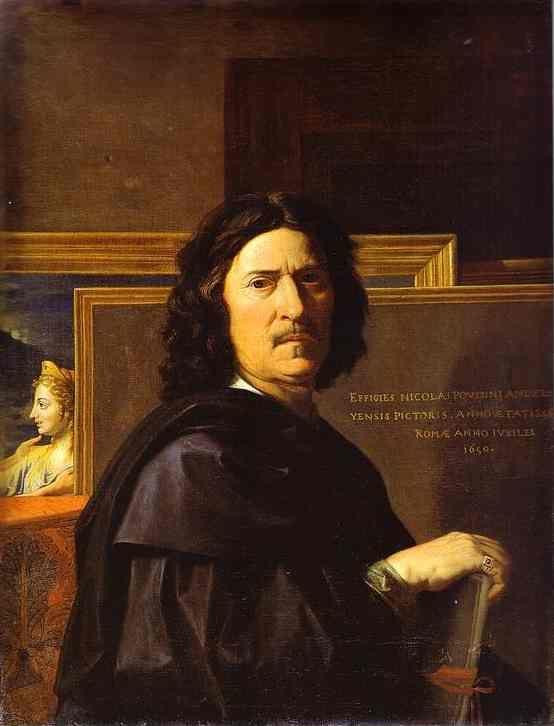
Pious Poussin

This last weekend afforded an informative tromp through the recent history of western art, from post-Renaissance Poussin, to pre-shock art Courbet, concluding with a post-shock art Whitney Biennial (though the show has suffered generally negative reviews, a charitable mood can result in genuine refreshment from the inescapably theological video installations of Mika Rottenberg's and Javier Téllez).

The Poussin exhibit at the Met, however, was the strongest and - not coincidentally - oldest of the three exhibitions. Historian John Walford once asked a mysteriously silent student what he had thought of an intro art history course. Having not said anything all semester, the student immediately exclaimed: "Poussin - What an artist!" and went on to write a dissertation on the subject.

Poussin has long had such an effect, transfixing characters as diverse as Bernini, Wordsworth or Diderot; so it's perhaps unfair to compare him to the Biennial, or even to the indisputably brilliant Courbet (but I will). The Met's show - which, I regret to relate, is now concluded - focused on landscape, showing off how Poussin cast trees, wind and mountains as characters in his imposing dramas. With Poussin, landscape is dignified by human presence, human presence is dignified by landscape. As one of my museum companions observed, Courbet's figures, in contrast, are frequently disproportionate to their contexts. Stylistically, Poussin somehow synthesized the energies of Classicism and Baroque. Thematically, he brought together Christian and Classical themes. "The gulf between pagan and Christian art that had opened up during the Italian Renaissance," writes the esteemed Grove, "is reconciled by Poussin's strong sense of historical continuity."

Neither of Poussin's Seven Sacrament series were here displayed, but as the religious side of Poussin is ignored by many, perhaps this is just as well. We get the Poussin we deserve. But one cannot ultimately ignore the obvious. Art historian Anthony Blunt called Poussin a "a pure example of the Christian Stoic," and in the exhibit one can see how Poussin matured beyond the pornographic forays of his early career, (to be taken with a grain of Psalter), into his spiritually mature accomplishments. Courbet, again by contrast, counted pornography the fillet of his artistic achievement.

Karen Wilkin, in her celebratory review of this "fiercely intelligent exhibition" suggests that Poussin's Saint John on Patmos may be asserting "the instability of the pagan world in the face of Christianity." Furthermore, having now seen Landscape with a Man Killed by a Snake in the original, I proudly stick by my thesis (self-link: drink!) as to its sublimated religious content. One Poussin scholar who responded to my earlier post seems to concur. No word yet from T.J. Clark.

But, of course, a Christian gloss on Poussin (however justified for the lack of scholarly attention to his faith), is not the story whole. The Louvre's more famous version of Et in Arcadia Ego was not in this exhibit, though an earlier manifestation of it, before the death theme was completely eclipsed, did appear. Erwin Panofsky's noted essay on art history's favorite Latinism shows how a medieval momento mori was transformed into a clouded euphamism. The Poussin painting on view showed a freeze frame in this unfortunate development, that is, from Gospel to Goth.
"Poussin... no longer shows a dramatic encounter with Death but a contemplative absorption in the idea of mortality. We are confronted with a change from thinly veiled moralism to undisguised elegiac sentiment."
Poussin hadn't then been reading his John Climacus, who in rung six of the Heavenly Ladder explained, "Just as bread is the most necessary of all foods, so the thought of death is the most essential of all works." A society that turns its graveyards into cemeteries and its parlors into "living rooms" (as ours did at the end of the nineteenth century) is in sad condition indeed. Poussin's Arcadia paintings may have contributed, however innocently, to the same development in Europe. Give me Guercino instead.

As the perceptive group I enjoyed the exhibit with gathered around Poussin's landscapes - giving them much of the meditative attention they deserve - the acres of canvas sparked delightful conversation, moreso than even film. One in our group, Adam, referenced Marshall McLuhan's idea of hot and cool media (from Understanding Media: The Extensions of Man). Cool media, unlike hot, demands something of its viewers, but can often give so much more. Poussin, the case in point, is eminently cool, and therefore demands much. Like Poussin, MacLuhan's faith is also frequently ignored (or not even realized). "In Jesus Christ," wrote MacLuhan, "there is no distance or separation between the medium and the message. It's the one case where we can say that the medium and the message are fully one and the same."

In Poussin, the medium and the message are wonderfully blurred as well (if not entirely unified), which puts those who wish to ignore his Christianity in an art historically sanctioned bind. But there's enough Poussin to please even those without eyes to see this essential component. Before Bohemian Courbet, who could fill an entire room with brooding self-portraits, there was the disciplined Poussin who (in this exhibit at least), provides us only one. The point, Poussin seems to be indicating, is not Poussin. Art, as always and like everything, must lose itself to be found.

Gladly, this is something at least a few artists at the 2008 Biennial seem also to have understood.

update: Incidentally, I can be nicer about Courbet (self link: drink!).

Tuesday, May 06, 2008

Actual Gadfly

In a Books & Culture review of a book on Bill Bright, Stephen H. Webb makes a characteristically insightful observation:
The campus radicals failed in their bid to take over the universities, but they went on to dominate them as professors. They also went on to dominate our collective understanding of the Sixties, but their scholarship systematically overlooks student movements that do not fit their narrow understanding of social activism. Liberal professors have exhaustively examined Woodstock as much as they studiously neglected "Explo '72" (short for "spiritual explosion"), but the 85,000 college and high school students who gathered in Dallas to listen to Christian rock and learn how to witness to their faith went on to impact their universities as much or more than the crowds who partied on Max Yasgur's farm. Likewise, precious few university history courses would ever acknowledge that the "Four Spiritual Laws" have had a cultural impact completely disproportionate to the much acclaimed 1962 Port Huron Statement by Students for a Democratic Society.
Such thoughts are expanded upon in an address, posted today, that Webb gave to incoming students at Wabash College. Webb diagnoses contemporary academia from a Christian perspective (in short: human nature exists, and whatever it is, Christ has it). Webb then gives advice to incoming students on how to engage the strange creatures that haunt much of academe: Humans who eschew human nature.

Most of my colleagues in academia with no religious commitment might, on a good day, read the analysis and respond: Now there's a gadfly, that is, someone who is truly challenging my presuppositions. What good is the lauded Socratic gadfly if it doesn't actually annoy you? Now here, I can imagine them possibly saying, is a colleague who would make for interesting conversation. Here, might they muse, is the "other." Perhaps such were the thoughts that went through the mind of the Wabash committee that tenured Webb. Perhaps Webb's success also owes something to a wide dissatisfaction with the multicultural stalemate he describes.

Some Christian responses to Webb's address would, I imagine, be much more troubling. Webb's rhetoric will, I assure you, make the sophistichristians deeply nervous. It's not really that bad (say those who have spent most of their time in Christian circles). The ideas Webb decries are in fact helpful (say those who use them as surgical tools to perform doctrinal lobotomies). We need to engage more (say those who enjoy little actual engagement with secular colleagues). No, folks, this is engagement, and it can (must!) be done with a smile, not a scowl.

Webb might have also pointed out that if one is genuinely interested in multiculturalism, the Christian faith has a decent track record on that front. Many failures have there been, but these despite, not because of the charter. "Christ against the multiculturalists" may then indeed be an appropriate position, but after being against them, he can still give them what they seek, but on very different terms.

Wednesday, April 30, 2008

For the theologically inclined, a pop quiz: Whose theology does the following sentence describe?

"The human person only understands his or her identity to the extent that he or she is open to a relationship with Christ. Christology is deemed necessary for any adequate anthropology."

Hint: The name starts with "B".

ANSWER: Les jeux sont faits. (Bueller reference: drink!) The sentence is a description of current papal theology from the book nicely encapsulated here by Ryan Anderson.

The quotation is curious because the sentence sounds like it was pulled straight from some Barth 101 lecture notes. Open up his Church Dogmatics to III.2, the section on anthropology, and there in boldface are the words: "As the man Jesus is Himself the revealing Word of God, He is the source of our knowledge of the nature of man as created by God." What follows is a lengthy unpacking of the idea that only through Christ can we know what we, as humans, truly are. This in contrast to the notion that we first go to external anthropologies and attempt then to blend them with Christian faith.

In the long run (face it we must), most people aren't going to read Karl Barth. On a popular level, however, the way most people will make contact with Barth's ideas may, ironically enough, be thanks (via Balthasar) to Pope Benedict XVI. Is it possible, as some at the analogia entis conference seemed to cautiously imply, that the safest place to be a Barthian today is the Catholic church?

Conversely, for popular level Protestantism, consider one de facto Protestant spokesperson Anne Lamott in a mock - but nevertheless real - Sunday School teacher showdown with Catholic Colbert.

Friday, April 25, 2008

the upside of ugly

Something positive may have come out of the abortion art antics. Consider that it makes Christian offers to write the art world a blank check look increasingly ridiculous. In short, the Tillichian paradigm, which I've tried to criticize here and more recently here (self-link: drink!), has passed its expiration date.

Things, however, may be changing. I'm aware of no "Go sister" Christian endorsements (if they're out there, don't tell me). Moreover, new confidence can be found in insightful analyses from First Things and Image. Ian Marcus Corbin laments the intellectual disarmament that incapacitates Shvarts' would-be critics, and Lucas Kwong bemoans the eclipse of art as "an autonomous object of beauty, subject to neither politics nor profit."

Add these to Dan Siedell's directing us toward a more Pauline (the apostle, that is) mode of engagement, and we have an encouraging prognosis of Christians and contemporary art. Not grumpy, but guarded; not yelling, but yawning; not seeking to siphon, but to give.

UPDATE: Michael J. Lewis chimes in with some measured reflections:
"It is often said that great achievement requires in one's formative years two teachers: a stern taskmaster who teaches the rules and an inspirational guru who teaches one to break the rules. But they must come in that order. Childhood training in Bach can prepare one to play free jazz and ballet instruction can prepare one to be a modern dancer, but it does not work the other way around. One cannot be liberated from fetters one has never worn; all one can do is to make pastiches of the liberations of others."

Thursday, April 24, 2008

Round-up

College roommates of mine may remember the "Basta ya, no mas brutalidad" signs I came home with from Chicago protests. The rush of fraternizing with what was left of the black panther party was just that, a rush. That's why R.R. Reno, in Opium and Revolution, is so right about why Marx was so wrong. Revolution is the drug; religion the smelling salt.

Also, in light of John Henry Newman's pending beatification, don't neglect this quote of his (via Oakes) that summarizes so much of Newman's project, a project that turns pluralism on its head:
"[T]he doctrine of a Trinity is found both in the East and in the West; so is the ceremony of washing; so is the rite of sacrifice. The doctrine of the Divine Word is Platonic; the doctrine of the Incarnation is Indian; of a divine kingdom is Judaic; of Angels and demons is Magian [Zoroastrian]; the connection of sin with the body is Gnostic; celibacy is known to Bonze and Talapoin [Burmese and Cambodian Buddhists]; a sacerdotal order is Egyptian; the idea of a new birth is Chinese and Eleusinian [pagan Greek]; belief in sacramental virtue is Pythagorean; and honors to the dead are a polytheism.... [Yet] So far from her creed being of doubtful credit because it resembles foreign theologies, we even hold that one special way in which Providence has imparted divine knowledge to us has been by enabling her to draw and collect it together out of the world."
Furthermore, should one not have time to work through the Benedict addresses, this quote I came across from Carl A. Anderson adequately encapsulates his pontifical teaching thus far: "His encyclicals make a great effort to explain why... Christian hope differs from simple optimism or the secular idea of progress, and why Christian charity differs from government welfare or social services."

And finally, a few shots of Princeton in Spring.

Tuesday, April 22, 2008

The Pope pics are in! The texts (PDF file) are even better.

We were indebted for our tickets to the Sisters of Life, hence our group paid them a visit the next day. Mass at the convent had some 57,525 less people than Yankee Stadium (there were about 20 of us), yet strangely, it was far more intense.

Sunday, April 13, 2008

an ornithology of art

My diagnosis of contemporary art, an ecumenical cure, along with an homage to my undergrad art history professor can all be found in the current feature article of the Catholic literary journal Dappled Things. Don't miss the rest of the issue as well.

Monday, April 07, 2008

Analogia Entis conference

When seeking clarity on a controversial issue, a heavy-hitting theology conference is not the first place to go. But for the time spent with friends, and the chance to see professionals articulate matters so much more knowledgably than I, it was well worth the trip. I came away with a better grasp of what generates both my admiration and anxiety with Karl Barth, and with a glimpse of the possibilities when perspicacious Catholics appropriate his best insights. Reinhard Hütter may have been onto something when he said the issue is not as divisive as it's made out to be, and is far from the top of the ecumenical priority list.

While it would be preposterous to attempt to sum up the nuance and sophistication of the entire weekend in one photograph, perhaps I did so above. That or I'm on the shortlist to be Thomas Kinkade's staff photographer.

Lest the message of that summarizing photograph seem too Catholic, at least I didn't pick this one.

UPDATE: Perhaps this photo encapsulates the conference even more adequately.