Tuesday it was off to New York, or
Neah Iorkee as my Modern Greek teacher says it's pronounced. And as it was the first day of the transit strike I enjoyed a semi-deserted city while delighting in the occupational hazard of having to see exhibits before they move.
Folks, the Cold War is definitely over (you heard it here first). This I know from the fact that both
Russia and the once Soviet-blocked
Czechoslovakia are strutting their cultural stuff for all to see. It's nice to experience their national treasures instead of their nuclear warheads.
RussiaBecause the trajectory of Russian art basically parallels that of "Western" art, it provides a refreshing twist on the tired art historical canon while still imparting similar lessons. First came the icons, and it was worth the trip alone to see a real
Andrei Rublev... but rather than submit icon writing to the Western cult of the artist as I did in that last sentence, better yet was seeing one of two genuine copies of the famous
Madonna of Vladimir, traveling outside of Russia for the very first time.
Moving chronologically with the exhibit, next came
Peter the Great's inferiority complex where, in the original
perestroika, he tried to be Paris. But because imitation is boring... fast forward a century to when in the person of
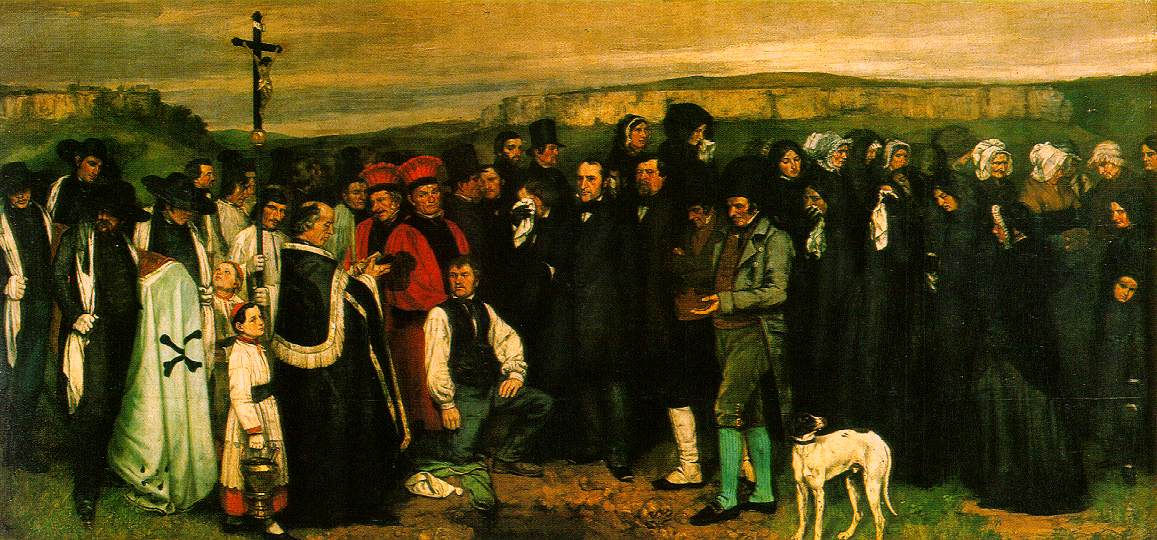
Vasily Perov, Russia produced her own
Courbet (cf.
this with
this). Perov also gave us an enduring portrait of
Dostoevsky (not at the exhibit), but my favorite was
this. Though perhaps an exaggeration, still it may accurately reflect the kind of decadent Christian culture that led eventually to Lenin. It wouldn't be the first time that the
poor behavior of the people of God contributed to a disaster of epic proportion.
Next came the
Wanderers, the Russian equivalent to Romanticism, and the exhibit ended with some moderns. But unfortunately everyone's favorite Russian painting,
Roses for Stalin, wasn't there.
Prague and Van Gogh I didn't get to do Prague on my Grand Tour this summer, but that's alright because Prague came to me (the world has
yet to learn). Though some may find it silly that so much of the artifacts in the Prague exhibit were made to house relics - how is that sillier than the scores of crowds crawling over one another to see an etch that was but a preparatory drawing for a painting by
Van Gogh? Answer that to my satisfaction and I'll send you a dollar in the mail (sorry, one winner only).
Not that I'm against Vincent (see #
9). He is the subject of my
favorite song, and I even listened to Kevin Bacon's (!?) Met-sponsored
reading of the letters to Theo. But though some (actually, one in particular) of the drawings were so good they elicited a gasp, still I find the
cult of the saints much less of a stretch than the cult of the artist. Van Gogh himself, as Kathleen Powers Erickson's
book has explored, was interested throughout his
entire career, in a very different kind of God.
Though the Prague exhibit was primarily Catholic, I left convinced that the Protestant case for art only gets stronger. Not only to we have the chief Reformer on
record for art, but the exhibit explained that a century before him Prague's proto-Reformer
Jan Huss made similar defenses of images against
his more radical followers.
MOBIAThe way most museums are laid out, and the way many art historians speak today, you'd think that religious painting was phased out after the Enlightenment. I've even heard respected art historians infer as much. With such a perspective (or lack thereof), it's hard to make sense of or
this journal or
this organization... so they often just get ignored. And while sorry to disappoint, as I've mentioned
before, religious painting is experiencing a sort of
rinascimento right there in
Neah Iorkee.
And though I just missed the
Next Generation exhibition at the
MOBIA, and least I was glad to see the contributors have been collected in
this book for future reference.
Finally, Merry Christmas everyone... especially to those of you who read this far. And to avoid that Dec. 26th let-down feeling, remember, it's a
season, not a day.