Friday, May 30, 2008

academy bashing

Declaring what's wrong with higher education is as an industry. Books and articles on the subject appear like the trustworthy rising of the Nile, annually fertilizing the world's least justified case of bitterness: that of the graduate student.

Still, the process can be helpful. Ross Douthat (The Great Higher Education Debate) helpfully collates discussion around the current soil deposit. I am indebted to one commenter who provided the exact quotation from The West Wing that has been long lodged in my brain as a breathlessly facile example of what Charles Murray calls "Educational Romanticism." Education as the silver bullet? A silver bullet that had no effect on one of the 20th century's most horrifying secretions: The cultured Nazi.

Perhaps there will one day appear a German pope who, arising from such a context, understands the need for educators to also focus on student volition. Information, after all, cannot make people good. Perhaps such a pope (after shrewdly critiquing the American tradition of pragmatism) would say something like "while we have sought diligently to engage the intellect of our young, perhaps we have neglected the will." Perhaps.

In the meantime, I can't resist a little academy bashing of my own. Here's a quote from Wallace Stegner's poignant little novel, Crossing to Safety, that charts two couples tested by the tenure process. The one who succeeds, towards the end of his life, says this:
"Though I have been busy, perhaps over-busy all my life, it seems to me now that I have accomplished little that matters, that the books have never come up to what was in my head, and that the rewards - the comfortable income, the public notice, the literary prizes, and the honorary degrees - have been tinsel, not what a grown man should be content with."
And then there's this bit of dialog from the (somewhat saucy) film We Don't Live Here Anymore, also chronicling the lives of two academic couples:
Terry: Hank, people who know you like your work, you're being published. It doesn't get much better than that, does it?

Hank: It's a poem, Terry. It's really not that important.

Terry: No, Hank, it isn't. You want important go work in a cancer ward with people who are puking from chemo or teach math to a kid who has brain damage from fetal alcohol syndrome.

Hank: Those people generally aren't that much fun to be around.
Alright, enough bashing. Education is important, and uncertain as the path may be, the surprise ending to this clever piece should put things into perspective. I learned my lesson about complaining when, after murmuring about some funding to a grad colleague at a museum reception, a waiter mozied up to me with some hors d'ouvre, only to say, "Salmon truffle?"

Back to work.

Thursday, May 15, 2008

This boycott is very distressing. Didn't I settle the matter back in 2006? (self link: drink!)

Tuesday, May 13, 2008

Pious Poussin

This last weekend afforded an informative tromp through the recent history of western art, from post-Renaissance Poussin, to pre-shock art Courbet, concluding with a post-shock art Whitney Biennial (though the show has suffered generally negative reviews, a charitable mood can result in genuine refreshment from the inescapably theological video installations of Mika Rottenberg's and Javier Téllez).

The Poussin exhibit at the Met, however, was the strongest and - not coincidentally - oldest of the three exhibitions. Historian John Walford once asked a mysteriously silent student what he had thought of an intro art history course. Having not said anything all semester, the student immediately exclaimed: "Poussin - What an artist!" and went on to write a dissertation on the subject.

Poussin has long had such an effect, transfixing characters as diverse as Bernini, Wordsworth or Diderot; so it's perhaps unfair to compare him to the Biennial, or even to the indisputably brilliant Courbet (but I will). The Met's show - which, I regret to relate, is now concluded - focused on landscape, showing off how Poussin cast trees, wind and mountains as characters in his imposing dramas. With Poussin, landscape is dignified by human presence, human presence is dignified by landscape. As one of my museum companions observed, Courbet's figures, in contrast, are frequently disproportionate to their contexts. Stylistically, Poussin somehow synthesized the energies of Classicism and Baroque. Thematically, he brought together Christian and Classical themes. "The gulf between pagan and Christian art that had opened up during the Italian Renaissance," writes the esteemed Grove, "is reconciled by Poussin's strong sense of historical continuity."

Neither of Poussin's Seven Sacrament series were here displayed, but as the religious side of Poussin is ignored by many, perhaps this is just as well. We get the Poussin we deserve. But one cannot ultimately ignore the obvious. Art historian Anthony Blunt called Poussin a "a pure example of the Christian Stoic," and in the exhibit one can see how Poussin matured beyond the pornographic forays of his early career, (to be taken with a grain of Psalter), into his spiritually mature accomplishments. Courbet, again by contrast, counted pornography the fillet of his artistic achievement.

Karen Wilkin, in her celebratory review of this "fiercely intelligent exhibition" suggests that Poussin's Saint John on Patmos may be asserting "the instability of the pagan world in the face of Christianity." Furthermore, having now seen Landscape with a Man Killed by a Snake in the original, I proudly stick by my thesis (self-link: drink!) as to its sublimated religious content. One Poussin scholar who responded to my earlier post seems to concur. No word yet from T.J. Clark.

But, of course, a Christian gloss on Poussin (however justified for the lack of scholarly attention to his faith), is not the story whole. The Louvre's more famous version of Et in Arcadia Ego was not in this exhibit, though an earlier manifestation of it, before the death theme was completely eclipsed, did appear. Erwin Panofsky's noted essay on art history's favorite Latinism shows how a medieval momento mori was transformed into a clouded euphamism. The Poussin painting on view showed a freeze frame in this unfortunate development, that is, from Gospel to Goth.
"Poussin... no longer shows a dramatic encounter with Death but a contemplative absorption in the idea of mortality. We are confronted with a change from thinly veiled moralism to undisguised elegiac sentiment."
Poussin hadn't then been reading his John Climacus, who in rung six of the Heavenly Ladder explained, "Just as bread is the most necessary of all foods, so the thought of death is the most essential of all works." A society that turns its graveyards into cemeteries and its parlors into "living rooms" (as ours did at the end of the nineteenth century) is in sad condition indeed. Poussin's Arcadia paintings may have contributed, however innocently, to the same development in Europe. Give me Guercino instead.

As the perceptive group I enjoyed the exhibit with gathered around Poussin's landscapes - giving them much of the meditative attention they deserve - the acres of canvas sparked delightful conversation, moreso than even film. One in our group, Adam, referenced Marshall McLuhan's idea of hot and cool media (from Understanding Media: The Extensions of Man). Cool media, unlike hot, demands something of its viewers, but can often give so much more. Poussin, the case in point, is eminently cool, and therefore demands much. Like Poussin, MacLuhan's faith is also frequently ignored (or not even realized). "In Jesus Christ," wrote MacLuhan, "there is no distance or separation between the medium and the message. It's the one case where we can say that the medium and the message are fully one and the same."

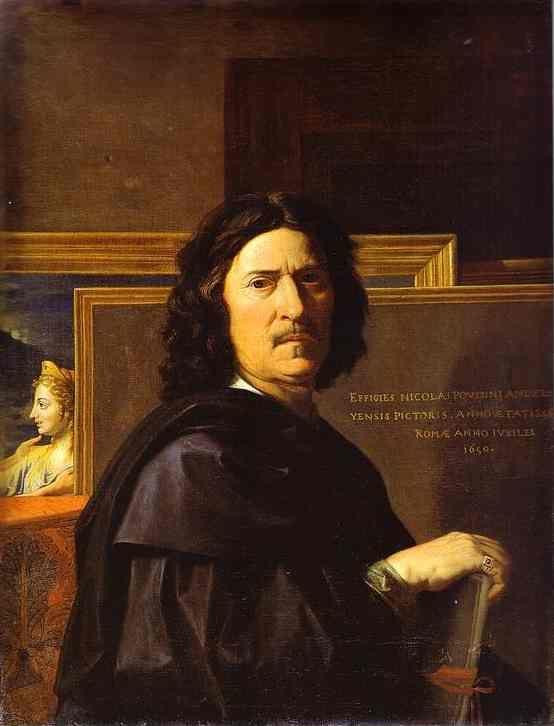
In Poussin, the medium and the message are wonderfully blurred as well (if not entirely unified), which puts those who wish to ignore his Christianity in an art historically sanctioned bind. But there's enough Poussin to please even those without eyes to see this essential component. Before Bohemian Courbet, who could fill an entire room with brooding self-portraits, there was the disciplined Poussin who (in this exhibit at least), provides us only one. The point, Poussin seems to be indicating, is not Poussin. Art, as always and like everything, must lose itself to be found.

Gladly, this is something at least a few artists at the 2008 Biennial seem also to have understood.

update: Incidentally, I can be nicer about Courbet (self link: drink!).

Tuesday, May 06, 2008

Actual Gadfly

In a Books & Culture review of a book on Bill Bright, Stephen H. Webb makes a characteristically insightful observation:
The campus radicals failed in their bid to take over the universities, but they went on to dominate them as professors. They also went on to dominate our collective understanding of the Sixties, but their scholarship systematically overlooks student movements that do not fit their narrow understanding of social activism. Liberal professors have exhaustively examined Woodstock as much as they studiously neglected "Explo '72" (short for "spiritual explosion"), but the 85,000 college and high school students who gathered in Dallas to listen to Christian rock and learn how to witness to their faith went on to impact their universities as much or more than the crowds who partied on Max Yasgur's farm. Likewise, precious few university history courses would ever acknowledge that the "Four Spiritual Laws" have had a cultural impact completely disproportionate to the much acclaimed 1962 Port Huron Statement by Students for a Democratic Society.
Such thoughts are expanded upon in an address, posted today, that Webb gave to incoming students at Wabash College. Webb diagnoses contemporary academia from a Christian perspective (in short: human nature exists, and whatever it is, Christ has it). Webb then gives advice to incoming students on how to engage the strange creatures that haunt much of academe: Humans who eschew human nature.

Most of my colleagues in academia with no religious commitment might, on a good day, read the analysis and respond: Now there's a gadfly, that is, someone who is truly challenging my presuppositions. What good is the lauded Socratic gadfly if it doesn't actually annoy you? Now here, I can imagine them possibly saying, is a colleague who would make for interesting conversation. Here, might they muse, is the "other." Perhaps such were the thoughts that went through the mind of the Wabash committee that tenured Webb. Perhaps Webb's success also owes something to a wide dissatisfaction with the multicultural stalemate he describes.

Some Christian responses to Webb's address would, I imagine, be much more troubling. Webb's rhetoric will, I assure you, make the sophistichristians deeply nervous. It's not really that bad (say those who have spent most of their time in Christian circles). The ideas Webb decries are in fact helpful (say those who use them as surgical tools to perform doctrinal lobotomies). We need to engage more (say those who enjoy little actual engagement with secular colleagues). No, folks, this is engagement, and it can (must!) be done with a smile, not a scowl.

Webb might have also pointed out that if one is genuinely interested in multiculturalism, the Christian faith has a decent track record on that front. Many failures have there been, but these despite, not because of the charter. "Christ against the multiculturalists" may then indeed be an appropriate position, but after being against them, he can still give them what they seek, but on very different terms.